

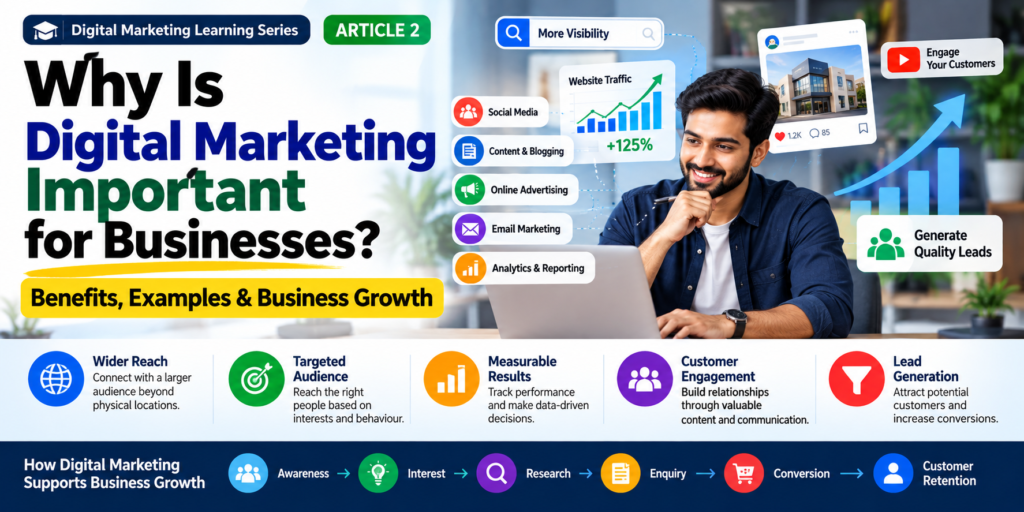
Why Is Digital Marketing Important for Businesses? Benefits & Examples
Today, customers use digital channels to discover businesses, research products and services, compare alternatives, read reviews, watch videos, communicate with brands and make purchasing decisions.
This is why understanding why digital marketing is important for businesses has become essential for business owners, entrepreneurs, marketing professionals and students.
Digital marketing allows businesses to build online visibility, reach relevant audiences, communicate with potential customers, generate leads and measure marketing performance through digital channels.
For example, a person looking for a digital marketing course may search Google, visit a website, read a blog, watch a video, check social media, compare different courses and finally submit an enquiry. Multiple digital marketing channels can influence different stages of this journey.
In this article, we will understand the importance of digital marketing, its major benefits, practical examples, its role for small businesses, and how businesses can use digital marketing to support growth.
Quick Answer: Why Is Digital Marketing Important?
Digital marketing is important because it helps businesses reach relevant audiences through digital channels, build online visibility, engage customers, generate leads, support sales and measure marketing performance.
Unlike a single traditional advertising channel, digital marketing can combine:
- SEO
- Websites
- Blogging
- Social media
- Online advertising
- Email marketing
- Video marketing
- Local SEO
- Analytics
- Lead generation
Digital marketing also provides measurable data that can help businesses understand how people interact with their marketing activities and where improvements may be needed. Google describes measurement and attribution as important for understanding customer interactions across the journey.
What Makes Digital Marketing Important for Modern Businesses?
The customer journey is no longer limited to visiting a physical store or responding to a newspaper advertisement.
A potential customer may:
Search → Read → Watch → Compare → Visit Website → Enquire → Purchase
Digital marketing helps businesses participate in these different touchpoints.
For example, a student looking for an MBA course might:
- Search Google for MBA colleges.
- Read an educational blog.
- Watch a college video.
- Visit the college website.
- Check Instagram or LinkedIn.
- Compare courses.
- Fill out an enquiry form.
- Speak with an admission counsellor.
The business can use different digital channels to support this journey.
1. Digital Marketing Helps Businesses Reach More People
One of the major advantages of digital marketing is its ability to connect businesses with audiences beyond their immediate physical location.
A business can potentially reach:
- Local customers
- City-level audiences
- National audiences
- International audiences
For example, a local coaching institute in Delhi can use local SEO and online advertising to reach students searching for relevant courses.
An e-commerce business can use digital channels to reach customers across different cities and regions.
The actual reach depends on the channel, targeting, budget, competition and marketing strategy.
2. Digital Marketing Helps Businesses Reach Relevant Audiences
Digital marketing provides many ways to define and reach relevant audiences.
Depending on the platform and campaign, businesses may be able to use factors such as:
- Location
- Search behaviour
- Interests
- Demographics
- Website interactions
- Previous engagement
- Customer lists, where permitted
For example, instead of advertising a digital marketing course to everyone in a city, a business can build campaigns around people searching for relevant courses or audiences matching specific campaign criteria.
This can make marketing communication more relevant.
3. Digital Marketing Helps Build Online Visibility
Imagine two businesses offering similar services.
One has:
- A website
- Useful blog content
- Search visibility
- Social media activity
- Customer reviews
- Helpful videos
The other has very little online information.
When potential customers research both businesses online, the first business may have more opportunities to be discovered and evaluated.
Digital visibility can be developed through:
- SEO
- Content marketing
- Social media
- Video marketing
- Local SEO
- Online advertising
A strong online presence does not guarantee sales, but it can create more opportunities for people to discover and evaluate a business.
4. Digital Marketing Supports Customer Research
Customers often research before making decisions.
For example, someone planning to buy a laptop might search:
Best laptop for students
Then:
Laptop comparison
Then:
Laptop under ₹60,000
Finally:
Buy laptop online
The business can create different types of content for different stages of this journey.
This is why digital marketing is not only about advertisements.
It also includes:
Helpful information + content + search visibility + communication + conversion opportunities
5. Digital Marketing Is Measurable
One of the important characteristics of digital marketing is the availability of performance data.
Depending on the channel, marketers can measure:
- Impressions
- Clicks
- Click-through rate
- Website visits
- Engagement
- Leads
- Purchases
- Conversion rate
- Cost per lead
- Advertising spend
- Revenue
For example:
A campaign receives:
20,000 impressions
↓
1,000 clicks
↓
100 enquiries
↓
10 customers
A marketer can analyse each stage and identify areas for improvement.
Google’s advertising documentation describes conversion measurement as a way to understand valuable customer actions such as purchases, sign-ups and phone calls after interactions with advertising.
6. Digital Marketing Helps Businesses Generate Leads
A lead is a potential customer who has shown interest and provided an opportunity for further communication.
For example:
A website visitor may:
- Fill out an enquiry form
- Request a callback
- Call the business
- Send a WhatsApp message
- Download a resource
- Register for an event
A simplified lead-generation funnel is:
Search / Advertisement
↓
Website
↓
Useful Content
↓
Call-to-Action
↓
Lead Form
↓
Lead
↓
Follow-up
↓
Customer
This is particularly useful for businesses such as education, real estate, healthcare, professional services and B2B companies.
7. Digital Marketing Supports Customer Engagement
Marketing is not only about getting a customer.
Businesses also need to communicate with existing customers.
Digital channels can support:
- Customer questions
- Feedback
- Educational content
- Product updates
- Announcements
- Community building
- Customer support
For example, a restaurant can use social media to share new menu items, events and customer-focused content.
An educational institution can share:
- Events
- Student achievements
- Course updates
- Campus activities
This creates additional opportunities for interaction between the business and its audience.
8. Digital Marketing Helps Build Brand Awareness
Brand awareness means how familiar people are with a brand.
Businesses can use:
- Social media
- Blogs
- Videos
- Search visibility
- Display advertising
- Influencer collaborations
to repeatedly communicate useful and relevant information.
For example, a digital marketing training brand may publish:
- SEO guides
- PPC tutorials
- Digital marketing videos
- Student resources
- Industry updates
Over time, consistent useful content can help establish the brand within its target topic or market.
9. Digital Marketing Can Support Small Businesses
Digital marketing is not limited to large companies.
A small business can start with a focused strategy.
For example, a local restaurant could begin with:
Google Business Profile
Local SEO
Instagram content
Website
Customer reviews
Location-based advertising
A small business does not necessarily need to use every digital marketing channel at the same time.
A better approach is to identify:
Target audience → Business objective → Appropriate channel → Measurement
Google’s small-business marketing guidance also emphasizes measuring website traffic, clicks and conversions to understand which online marketing activities are producing valuable results.
10. Digital Marketing Allows Continuous Optimization
Traditional advertising can sometimes be difficult to modify after it has been published or aired.
Digital campaigns can often be reviewed and adjusted using available performance data.
For example, a business may discover that:
- One advertisement receives more clicks.
- One landing page generates more enquiries.
- One keyword produces higher-quality leads.
- One blog receives significant search impressions.
- One social media format receives more engagement.
The marketer can use these insights to test improvements.
This creates a cycle:
Launch → Measure → Analyse → Improve → Test Again
Google’s current marketing guidance emphasizes using measurement across customer journeys to understand performance and optimize campaigns.
11. Digital Marketing Helps Businesses Compete Online
Customers can compare multiple businesses within minutes.
For example, before choosing a service provider, a customer may compare:
- Website
- Pricing
- Reviews
- Services
- Social media
- Content
- Testimonials
- Location
- Customer experience
This means businesses need to understand how they appear across digital touchpoints.
A strong digital strategy can help a business make its information easier to discover and evaluate.
12. Digital Marketing Supports Local Businesses
Digital marketing is particularly useful for businesses that serve specific geographic areas.
Examples include:
- Restaurants
- Schools
- Coaching centres
- Hospitals
- Clinics
- Salons
- Real estate agencies
- Local service providers
For example:
“Best digital marketing institute in Delhi”
A business serving Delhi can create relevant local content, maintain accurate business information and build a strong local search presence.
13. Digital Marketing Supports Content-Based Customer Education
Some products and services require customers to understand the problem before they make a decision.
This is where content marketing and blogging become important.
For example:
A cybersecurity company can publish:
How to Protect Your Business from Phishing Attacks
A digital marketing agency can publish:
What Is SEO?
A school can publish:
How to Choose the Right School for Your Child
The content answers customer questions while introducing the business as a potential solution.
14. Digital Marketing Helps Businesses Understand Customer Behaviour
Digital analytics can provide insights into how people interact with websites, apps and campaigns.
Businesses may analyse:
- Which pages people visit
- Which traffic sources perform well
- Which campaigns generate leads
- Which content receives engagement
- Which conversion points perform better
Google Analytics, for example, provides tools for understanding user behaviour and customer journeys across digital channels.
However, businesses should collect and use data responsibly and according to applicable privacy requirements.
15. Digital Marketing Can Support Business Growth
Digital marketing does not automatically create business growth.
However, it can support important business activities such as:
Visibility
↓
Traffic
↓
Engagement
↓
Leads
↓
Sales
↓
Customer Retention
The actual outcome depends on many factors, including:
- Product or service quality
- Market demand
- Competition
- Pricing
- Website experience
- Sales process
- Marketing execution
- Customer experience
Therefore, digital marketing should be treated as part of a broader business strategy.
Digital Marketing Example: Education Business
Let’s take a practical example.
Suppose an institute wants to increase enquiries for its MBA program.
SEO
Create articles such as:
What Is an MBA?
MBA Eligibility Guide
Career Options After MBA
Google Ads
Target relevant searches through paid advertising.
Social Media
Publish:
- Student stories
- Campus videos
- Faculty content
- Events
- Course information
YouTube
Create educational videos about MBA careers and admissions.
Landing Page
Provide:
- Course information
- Eligibility
- Fees
- Benefits
- Enquiry form
Analytics
Measure:
- Traffic
- Enquiries
- Conversion rate
- Lead source
The result is a connected digital marketing system.
Digital Marketing for Different Types of Businesses
| Business | Useful Digital Marketing Activities |
|---|---|
| Education | SEO, Google Ads, social media, lead generation |
| Healthcare | SEO, local SEO, educational content |
| Real Estate | SEO, paid ads, property pages, lead generation |
| E-commerce | SEO, shopping campaigns, social media, email |
| Travel | SEO, content, social media, paid advertising |
| Restaurant | Local SEO, social media, reviews |
| B2B | SEO, LinkedIn, content, email, lead generation |
| Local Services | Local SEO, reviews, website, search advertising |
The right combination depends on the business model, target audience and objective.
What Are the Most Important Benefits of Digital Marketing?
The major benefits can be summarized as:
1. Wider Reach
Connect with audiences beyond a physical location.
2. Audience Relevance
Reach people using different targeting and intent signals.
3. Online Visibility
Help potential customers discover your business.
4. Measurability
Track important marketing activities and outcomes.
5. Lead Generation
Create opportunities for prospective customers to contact the business.
6. Customer Engagement
Communicate through multiple digital channels.
7. Content Distribution
Publish useful information for your audience.
8. Optimization
Use data to improve campaigns and content.
9. Scalability
Digital activities can often be expanded as business needs change.
10. Customer Journey Support
Connect multiple touchpoints across discovery, research, consideration and conversion.
Common Mistakes Businesses Make With Digital Marketing
Mistake 1: Using Every Platform
Being present everywhere is not necessarily the right strategy.
Start with channels relevant to your audience.
Mistake 2: Focusing Only on Traffic
Website traffic is useful, but businesses should also monitor meaningful actions such as enquiries, registrations, purchases or calls.
Mistake 3: Ignoring Website Experience
Driving traffic to a poor website may not generate good business results.
Mistake 4: Not Tracking Conversions
Without conversion tracking, it becomes difficult to understand which activities are contributing to business objectives.
Mistake 5: Expecting Instant SEO Results
SEO and content marketing often require consistent effort, quality content and time.
Mistake 6: Creating Content Without Understanding the Audience
Content should answer real audience questions and align with search intent.
Practical Exercise for Students
Choose one business.
For example:
Digital Marketing Training Institute
Now create the following:
| Question | Your Answer |
|---|---|
| Who is the target audience? | |
| What problem does the business solve? | |
| What would people search for? | |
| Which 3 digital channels should it use? | |
| What content could it publish? | |
| What could be the CTA? | |
| What would count as a conversion? |
Student Challenge
Create a simple funnel:
Audience → Channel → Content → Website → CTA → Lead → Conversion
This exercise will help you understand how digital marketing connects marketing activity with business objectives.
Key Takeaways
- Digital marketing helps businesses connect with audiences through digital channels.
- It can support awareness, discovery, engagement, lead generation and customer retention.
- Businesses can use SEO, content, social media, paid advertising, email, video and analytics together.
- Digital marketing provides measurable performance data.
- Small businesses can also use focused digital strategies.
- Traffic alone is not the final business objective; meaningful conversions and business outcomes matter.
- Successful digital marketing requires continuous testing, measurement and improvement.
Frequently Asked Questions
Why is digital marketing important for businesses?
Digital marketing is important because it helps businesses reach relevant audiences online, build visibility, communicate with customers, generate leads and measure marketing performance.
What are the main benefits of digital marketing?
Major benefits include wider reach, audience targeting, online visibility, measurable performance, customer engagement, lead generation, content distribution and campaign optimization.
Is digital marketing important for small businesses?
Yes. Small businesses can use focused digital strategies such as local SEO, content marketing, social media and search advertising to reach relevant audiences.
How does digital marketing help generate leads?
Digital marketing can bring potential customers to websites, landing pages, enquiry forms, phone calls, messaging channels and other conversion points.
How does digital marketing increase sales?
Digital marketing can support the customer journey by helping people discover a business, research its products or services, compare options and take actions such as making enquiries or purchases. Actual sales depend on factors beyond marketing, including product quality, pricing, competition and the sales process.
Why is measurement important in digital marketing?
Measurement helps businesses understand which marketing activities are producing valuable actions and where optimization may be needed. Google provides conversion-measurement tools for tracking actions such as purchases, sign-ups and calls.
Can digital marketing replace traditional marketing?
Not necessarily. Businesses can use digital and traditional channels together. The appropriate mix depends on the audience, business objectives, budget and marketing strategy.
Is digital marketing useful for local businesses?
Yes. Local businesses can use local SEO, websites, reviews, social media and location-focused advertising to reach customers in their service areas.
Conclusion
Digital marketing is important because the way people discover, research and interact with businesses has changed significantly.
A business can use digital channels to become more visible, provide useful information, communicate with its audience, generate enquiries and measure performance.
However, digital marketing should not be viewed simply as posting on social media or running advertisements.
A professional approach connects:
Audience → Strategy → Content → Channel → Website → Conversion → Measurement → Optimization
For students learning digital marketing, understanding this complete connection is one of the most important foundations before moving into specialized areas such as SEO, blogging, Google Ads, social media marketing and analytics.


Pingback: What Is Digital Marketing? Complete Beginner's Guide