

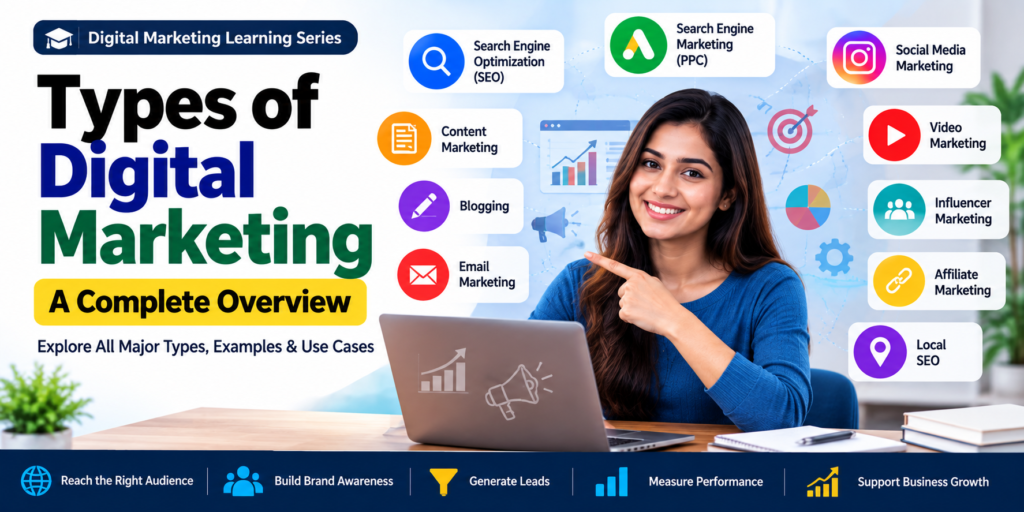
Types of Digital Marketing: Complete Guide to Major Types
Digital marketing is a broad field that includes multiple channels, strategies and techniques used to connect businesses with people through digital platforms.
When someone searches Google, watches a YouTube video, sees an Instagram post, reads a blog, clicks an online advertisement, receives an email or discovers a local business through search, they may be interacting with one or more forms of digital marketing.
Understanding the types of digital marketing is one of the first steps for anyone starting a career in digital marketing.
This guide explains the major types of digital marketing, how each works, where businesses use them, and practical examples for beginners.
Quick Answer: What Are the Types of Digital Marketing?
The major types of digital marketing include:
- Search Engine Optimization (SEO)
- Search Engine Marketing and PPC
- Social Media Marketing
- Content Marketing
- Blogging
- Email Marketing
- Video Marketing
- Affiliate Marketing
- Influencer Marketing
- Local SEO
- Mobile Marketing
- Online Reputation Management
- Marketing Analytics
- Conversion Rate Optimization
Not every business needs to use every channel. The appropriate combination depends on the business model, target audience, objectives, resources and customer journey.
What Are Digital Marketing Channels?
A digital marketing channel is a digital platform or method through which a business communicates with an audience or promotes its products and services.
For example:
- Google Search → SEO
- Google Ads → PPC
- Instagram → Social Media Marketing
- Website Blog → Content Marketing
- Email → Email Marketing
- YouTube → Video Marketing
A professional digital marketing strategy often combines several channels.
For example:
SEO + Content + Social Media + Paid Advertising + Analytics
can work together to support a business objective.
1. Search Engine Optimization (SEO)
Search Engine Optimization (SEO) is the process of improving a website and its content so that search engines can discover, understand and potentially show relevant pages to users.
SEO focuses primarily on organic search visibility, meaning unpaid search results.
Examples of SEO
A digital marketing website may publish:
What Is Digital Marketing?
A school website may publish:
How to Choose the Right School in Delhi
A travel website may publish:
Best Places to Visit in Himachal Pradesh
These pages can be optimized around relevant search queries and user needs.
Major Areas of SEO
SEO can include:
- Keyword research
- Search intent
- On-page SEO
- Technical SEO
- Content optimization
- Internal linking
- Local SEO
- Off-page SEO
- Website structure
Why SEO Matters
SEO can help businesses attract people who are actively searching for information, products or services.
2. Search Engine Marketing and PPC
Pay-per-click (PPC) is a form of online advertising in which advertisers can pay for clicks or other defined interactions depending on the advertising platform and campaign model.
Google Ads is one example of a major paid search advertising platform.
Example
A digital marketing institute wants to reach people searching for:
Digital marketing course online
It can create a paid search campaign targeting relevant searches.
The advertisement may lead the user to:
Ad → Landing Page → Enquiry → Counselling
PPC Can Be Used For
- Lead generation
- E-commerce sales
- Website traffic
- App promotion
- Brand awareness
- Event registrations
Unlike SEO, paid advertising can provide immediate opportunities for visibility after campaigns become eligible to serve, but results depend on factors such as budget, competition, relevance, targeting and campaign quality.
3. Social Media Marketing
Social media marketing involves using social platforms to build awareness, distribute content, engage audiences and support business objectives.
Popular platforms can include:
- YouTube
- X
- Other relevant social platforms
Example
A college may publish:
- Student testimonials
- Campus videos
- Faculty interviews
- Event photographs
- Course information
- Student achievements
Social media marketing can be:
Organic
or
Paid
Organic social media involves publishing content without paying for distribution as an advertisement.
Paid social media involves advertising through the platform.
4. Content Marketing
Content marketing focuses on creating and distributing useful, relevant content for a defined audience.
Content may include:
- Blog posts
- Guides
- Videos
- Infographics
- Case studies
- Podcasts
- Webinars
- Social media content
- E-books
Example
Suppose a digital marketing company wants to attract business owners.
It could publish:
How to Generate Leads Through Digital Marketing
The article provides useful information while introducing the company’s expertise and services.
Content Marketing Funnel
Awareness
↓
Information
↓
Engagement
↓
Consideration
↓
Lead
↓
Customer
5. Blogging
Blogging is closely connected with content marketing and SEO.
A blog allows a business to publish educational, informational or commercial content around topics relevant to its audience.
Example
A digital marketing training website can publish:
- What Is SEO?
- What Is Keyword Research?
- How to Write an SEO Blog?
- What Is Google Ads?
- What Is Social Media Marketing?
These articles can help students learn while also creating opportunities for organic search visibility.
Blogging Can Support
- SEO
- Brand awareness
- Audience education
- Organic traffic
- Lead generation
- Thought leadership
6. Email Marketing
Email marketing involves communicating with customers, prospects or subscribers through email, subject to applicable consent, privacy and communication requirements.
Businesses can use email for:
- Newsletters
- Educational content
- Product updates
- Offers
- Event invitations
- Lead nurturing
- Customer communication
Example
A student downloads a digital marketing guide and voluntarily subscribes to receive additional resources.
The business can then send relevant educational emails according to its communication permissions and strategy.
Email Marketing Funnel
Subscriber
↓
↓
Engagement
↓
Website Visit
↓
Action
↓
Conversion
7. Video Marketing
Video marketing uses video content to communicate information, demonstrate products, educate audiences or promote a brand.
Examples include:
- YouTube videos
- Tutorials
- Product demonstrations
- Webinars
- Interviews
- Short-form videos
- Educational videos
Example
A digital marketing institute could create a YouTube video:
“What Is SEO? Beginner’s Guide”
The video can educate students and direct interested viewers to additional learning resources.
8. Affiliate Marketing
Affiliate marketing is a performance-based marketing model where affiliates promote products or services using trackable links or other mechanisms.
Depending on the affiliate program, the affiliate may receive compensation for qualifying actions.
Example
A technology website publishes:
Best Laptops for Students
The article contains affiliate links to products.
If a visitor completes a qualifying purchase through an affiliate link, the publisher may receive a commission under the program’s terms.
Affiliate Marketing Participants
Typically:
Merchant/Brand
↓
Affiliate
↓
Audience
↓
Qualifying Action
↓
Commission
9. Influencer Marketing
Influencer marketing involves collaborating with creators or individuals who have an established audience or community.
Businesses may work with influencers to promote:
- Products
- Services
- Events
- Courses
- Apps
- Brands
Example
A fitness brand may collaborate with a fitness creator to demonstrate how its product is used.
The important factor is not simply the number of followers.
Businesses should also consider:
- Audience relevance
- Engagement
- Content quality
- Brand fit
- Campaign objective
- Transparency
- Budget
10. Local SEO
Local SEO focuses on improving visibility for searches related to a specific geographic location.
Examples:
Digital marketing institute in Delhi
Best restaurant in Janakpuri
Dentist near me
Local SEO is particularly useful for businesses that serve customers in specific geographic areas.
Local SEO Activities
These may include:
- Business profile optimization
- Local landing pages
- Reviews
- Accurate business information
- Local content
- Location pages
- Relevant citations
- Structured data
Example
A local restaurant can optimize its online presence so potential customers can discover:
- Restaurant name
- Location
- Opening hours
- Menu
- Reviews
- Contact information
11. Mobile Marketing
Mobile marketing focuses on reaching audiences through mobile devices.
It can include:
- SMS marketing
- Mobile applications
- Push notifications
- Mobile-friendly websites
- Mobile advertising
- Messaging platforms
Example
An e-commerce business may send an appropriate promotional notification through its mobile app to users who have opted to receive such communications.
Because smartphones are frequently used for search, communication and online transactions, mobile experience is an important consideration in digital marketing.
12. Online Reputation Management
Online Reputation Management (ORM) involves monitoring and managing how a brand, organization or individual appears across online platforms.
It can involve:
- Reviews
- Customer feedback
- Search results
- Social media mentions
- Business listings
- Public responses
Example
A hotel receives a negative review.
The business can:
- Read the customer’s complaint.
- Respond professionally.
- Investigate the issue.
- Resolve the problem where appropriate.
- Encourage genuine customers to share honest feedback.
ORM is not about removing every negative comment. It is about managing online presence responsibly and responding to customers appropriately.
13. Marketing Analytics
Marketing analytics involves collecting, analysing and interpreting marketing data to understand performance.
Important metrics can include:
- Impressions
- Clicks
- CTR
- Users
- Sessions
- Engagement
- Leads
- Conversion rate
- Cost per lead
- Revenue
- Return on advertising spend
Example
Suppose a campaign produces:
50,000 impressions
↓
2,500 clicks
↓
200 leads
↓
25 customers
A marketer can analyse the performance at each stage.
Analytics helps answer questions such as:
- Which channel is generating traffic?
- Which campaign is generating leads?
- Which landing page converts better?
- Which keywords generate impressions?
- Where are users dropping out?
14. Conversion Rate Optimization (CRO)
Conversion Rate Optimization (CRO) focuses on improving the percentage of visitors who complete a desired action.
A conversion might be:
- Purchase
- Registration
- Enquiry
- Form submission
- Phone call
- Download
- Demo request
Example
Suppose a landing page receives:
1,000 visitors
and generates:
20 enquiries
Its conversion rate is:
20 ÷ 1,000 × 100 = 2%
A marketer can test changes such as:
- Headline
- CTA
- Form length
- Page layout
- Trust information
- Content
- User experience
The objective is to improve the proportion of visitors who complete the desired action.
How Do Different Types of Digital Marketing Work Together?
One of the most important concepts for students is that digital marketing channels do not always work independently.
Consider an education business.
SEO
A student searches:
MBA colleges in Delhi
↓
Finds the website.
Blogging
The student reads:
MBA Admission Guide
↓
Social Media
The student discovers the institution’s Instagram page.
↓
YouTube
The student watches a campus video.
↓
Paid Advertising
The student later sees a relevant advertisement.
↓
Landing Page
The student visits the course page.
↓
Lead Generation
The student submits an enquiry.
↓
Analytics
The marketing team measures the source and conversion.
This is an example of an integrated digital marketing approach.
Digital Marketing Types: Quick Comparison
| Type | Main Purpose | Example |
|---|---|---|
| SEO | Organic search visibility | Ranking for relevant searches |
| PPC | Paid online visibility | Search advertisement |
| Social Media | Engagement & awareness | Instagram campaign |
| Content Marketing | Audience education | Blog guide |
| Blogging | Information & SEO | Educational article |
| Email Marketing | Communication & nurturing | Newsletter |
| Video Marketing | Visual communication | YouTube tutorial |
| Affiliate Marketing | Performance-based promotion | Affiliate review |
| Influencer Marketing | Creator-based promotion | Product collaboration |
| Local SEO | Local visibility | “Restaurant near me” |
| Mobile Marketing | Mobile audience engagement | App notification |
| ORM | Online reputation | Review management |
| Analytics | Measurement | Campaign reporting |
| CRO | Improve conversions | Landing-page optimization |
Which Type of Digital Marketing Should a Business Use?
There is no single digital marketing channel that is automatically right for every business.
The choice depends on:
1. Target Audience
Where does the audience search and consume information?
2. Business Objective
Is the goal:
- Awareness?
- Traffic?
- Leads?
- Sales?
- Customer retention?
3. Business Model
A local restaurant may need a different strategy from a global e-commerce company.
4. Budget
Paid advertising requires an advertising budget, while SEO and content require investment in expertise, time and resources.
5. Customer Journey
Some customers may need extensive research before purchasing.
Others may make quick purchasing decisions.
Example: Digital Marketing Strategy for a Small Business
Suppose you own a digital marketing training institute.
A possible strategy could be:
SEO
↓
Educational blog traffic
Social Media
↓
Audience engagement
YouTube
↓
Educational videos
Google Ads
↓
High-intent traffic
Landing Page
↓
Course information
Lead Form
↓
Enquiry
Email/WhatsApp
↓
Appropriate follow-up
Analytics
↓
Performance measurement
This shows why professional digital marketing requires coordination between different channels.
Common Mistakes Beginners Make
Mistake 1: Thinking Digital Marketing Means Social Media
Social media is only one part of digital marketing.
Mistake 2: Trying Every Channel
Beginners should understand the business objective before selecting channels.
Mistake 3: Ignoring SEO
Organic search can be an important source of relevant traffic for many businesses.
Mistake 4: Not Measuring Results
Without measurement, it is difficult to understand campaign performance.
Mistake 5: Focusing Only on Traffic
Traffic is not always the final objective.
Businesses should also measure meaningful actions such as enquiries, purchases or registrations.
Mistake 6: Using the Same Strategy for Every Business
A local restaurant, B2B software company and educational institution may need very different strategies.
Practical Exercise for Students
Choose one business.
For example:
Business: Digital Marketing Training Institute
Now complete this table:
| Digital Marketing Type | How Can the Business Use It? |
|---|---|
| SEO | |
| PPC | |
| Social Media | |
| Content Marketing | |
| Blogging | |
| Email Marketing | |
| Video Marketing | |
| Local SEO | |
| Analytics | |
| CRO |
Student Challenge
Choose three channels and explain:
- Why you selected them.
- What content or campaign you would create.
- What audience you would target.
- What action you want the audience to take.
- Which metric you would measure.
Key Takeaways
- Digital marketing consists of multiple channels and disciplines.
- SEO focuses on organic search visibility.
- PPC focuses on paid advertising.
- Social media helps businesses communicate and engage with audiences.
- Content marketing provides useful information to target audiences.
- Blogging can support content strategy and SEO.
- Email marketing supports communication and lead nurturing.
- Video marketing helps businesses communicate through visual content.
- Affiliate and influencer marketing use external partners or creators.
- Local SEO helps businesses reach geographically relevant audiences.
- Analytics helps marketers measure performance.
- CRO focuses on improving desired actions on digital properties.
- The best digital marketing strategy depends on the audience, business objective, business model and available resources.
Frequently Asked Questions
What are the main types of digital marketing?
The main types include SEO, PPC, social media marketing, content marketing, blogging, email marketing, video marketing, affiliate marketing, influencer marketing, local SEO, mobile marketing, online reputation management, analytics and conversion optimization.
Which type of digital marketing is best?
There is no universally best type. The appropriate channel depends on the business objective, target audience, customer journey, industry and resources.
Is SEO part of digital marketing?
Yes. SEO is one of the major disciplines within digital marketing.
Is blogging a type of digital marketing?
Blogging is generally considered part of content marketing and can also support SEO, brand awareness and lead generation.
What is the difference between SEO and PPC?
SEO focuses primarily on organic search visibility, while PPC involves paid advertising where advertisers pay for defined interactions depending on the platform and campaign model.
Is social media marketing digital marketing?
Yes. Social media marketing is one of the major areas of digital marketing.
Why is content marketing important?
Content marketing helps businesses provide useful information to their target audience and can support awareness, search visibility, engagement and conversions.
What is local SEO?
Local SEO focuses on improving a business’s visibility for relevant searches associated with a geographic location.
What is digital marketing analytics?
Digital marketing analytics involves collecting and analysing data from digital marketing activities to understand performance and support marketing decisions.
Can one business use multiple types of digital marketing?
Yes. Businesses commonly combine multiple channels. For example, a company might use SEO, content, social media, paid advertising and analytics together.
Conclusion
Digital marketing is not a single technique. It is a collection of interconnected channels and disciplines that businesses can use to reach, engage and convert digital audiences.
The major areas include SEO, PPC, social media marketing, content marketing, blogging, email marketing, video marketing, affiliate marketing, influencer marketing, local SEO, mobile marketing, analytics and conversion optimization.
For students, the most important lesson is to understand why and when each channel should be used, rather than simply memorizing definitions.
A professional digital marketer starts with the business objective, understands the target audience, selects appropriate channels, creates useful experiences, measures performance and continuously improves the strategy.


Pingback: What Is Digital Marketing? Complete Beginner's Guide