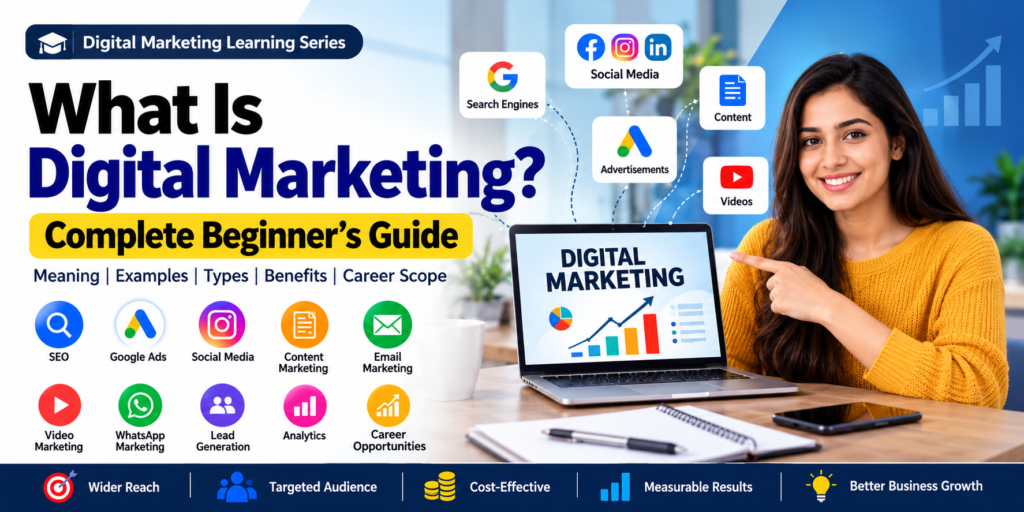
What Is Digital Marketing? Complete Beginner’s Guide
If you are beginning your journey in digital marketing, the first question you need to understand is: What is digital marketing?
In simple terms, digital marketing is the process of promoting a product, service, brand or business through digital channels such as search engines, websites, social media, email, online advertising, video platforms and mobile devices.
For example, when you search Google for a product, see an Instagram advertisement, read a company blog, watch a YouTube product video or receive an email from a business, you are interacting with different forms of digital marketing.
Digital marketing has become an important part of modern business because customers increasingly use digital channels to discover information, compare products, communicate with businesses and make purchasing decisions.
In this beginner’s guide, you will learn what digital marketing means, how it works, its major types, real-world examples, benefits, career opportunities and what you should learn as a beginner.
What Is Digital Marketing?
Digital marketing is the use of digital channels, platforms and technologies to promote a business, product, service or brand and connect with a target audience.
Digital marketing can include:
- Search engines
- Websites
- Social media
- Online advertising
- Blogs
- Video platforms
- Mobile applications
- Messaging platforms
- Online marketplaces
Unlike traditional marketing, many digital channels provide data that marketers can use to understand audience behaviour and campaign performance.
Simple Example
Suppose a digital marketing institute wants to attract students.
It could:
- Create a website.
- Publish blogs about digital marketing.
- Optimize those blogs for search engines.
- Run Google Ads.
- Publish Instagram and LinkedIn content.
- Create YouTube videos.
- Collect enquiries through a website form.
- Follow up with prospective students.
- Measure leads and conversions.
All these activities can form part of a digital marketing strategy.
What Does Digital Marketing Mean?
The term digital marketing consists of two basic concepts: digital and marketing.
What Does “Digital” Mean?
Digital refers to electronic and internet-based channels and technologies such as:
- Websites
- Search engines
- Smartphones
- Social media platforms
- Mobile applications
- Online advertising platforms
What Does “Marketing” Mean?
Marketing involves understanding a target audience and communicating the value of a product, service or brand to that audience.
Therefore:
Digital Marketing = Marketing + Digital Channels + Audience + Content + Data + Strategy
Digital marketing is not simply posting something on Facebook or Instagram. Professional digital marketing involves research, strategy, content, technology, advertising, analytics and continuous optimization.
How Does Digital Marketing Work?
Digital marketing generally works by connecting a business with people at different stages of their customer journey.
A simplified journey is:
Awareness → Interest → Research → Consideration → Conversion → Retention
Step 1 — Awareness
A person first discovers a business through:
- Google Search
- Social Media
- YouTube
- Online advertisements
- Blogs
- Videos
Step 2 — Interest
The person becomes interested in the product or service.
For example:
“Digital Marketing Course”
Step 3 — Research
The person may search for:
- Course syllabus
- Fees
- Duration
- Reviews
- Career opportunities
- Certification
- Placement information
Step 4 — Consideration
The person compares different options.
Step 5 — Conversion
The person may:
- Submit an enquiry
- Call the business
- Send a message
- Register
- Purchase
- Apply
Step 6 — Retention
The business can continue communicating with the customer through appropriate channels such as email, social media or other customer communication methods.
What Are the Main Types of Digital Marketing?
Digital marketing consists of several different disciplines.
1. Search Engine Optimization (SEO)
Search Engine Optimization (SEO) involves improving website content and technical elements so search engines can discover, understand and potentially rank relevant pages for users’ searches.
Example:
A digital marketing website publishes:
What Is Digital Marketing?
and optimizes the article for people searching for that topic.
SEO can include:
- Keyword research
- Search intent
- On-page SEO
- Technical SEO
- Internal linking
- Content strategy
- Local SEO
- Off-page SEO
2. Search Engine Marketing and PPC
Pay-per-click (PPC) advertising is a form of paid digital advertising in which advertisers can pay for clicks or other defined interactions, depending on the advertising platform and campaign model.
For example, a business may advertise when people search for:
“Digital marketing course online”
Google Ads is one of the major platforms used for search advertising.
3. Social Media Marketing
Social media marketing involves using social platforms to communicate with audiences, distribute content and support business objectives.
Examples include:
- Instagram marketing
- Facebook marketing
- LinkedIn marketing
- YouTube marketing
- X marketing
Businesses may use social media for:
- Brand awareness
- Engagement
- Community building
- Content distribution
- Lead generation
- Customer communication
4. Content Marketing
Content marketing focuses on creating and distributing useful and relevant content for a specific audience.
Content can include:
- Blog posts
- Videos
- Guides
- Infographics
- Case studies
- Podcasts
- Webinars
- Social media content
For example, a school may publish:
“How to Choose the Right School for Your Child”
This article can help parents while also introducing them to the school’s services.
5. Blogging
Blogging is an important part of content marketing and SEO.
Businesses use blogs to answer questions and provide useful information to potential customers.
Examples:
Education:
“Best MBA Colleges in Delhi”
Healthcare:
“How to Maintain a Healthy Lifestyle”
Travel:
“Best Places to Visit in Himachal Pradesh”
Real Estate:
“How to Choose the Right Property”
6. Email Marketing
Email marketing involves sending relevant communications to people who have subscribed, opted in, or otherwise have a valid business relationship with the sender, depending on applicable requirements.
Businesses can use email for:
- Newsletters
- Educational content
- Product updates
- Offers
- Lead nurturing
- Event invitations
- Customer communication
7. Video Marketing
Video marketing uses video content to communicate with audiences.
Examples include:
- YouTube videos
- Tutorials
- Product demonstrations
- Webinars
- Interviews
- Short-form videos
- Educational videos
8. Affiliate Marketing
Affiliate marketing is a performance-based model where affiliates promote products or services using trackable links or other mechanisms and may receive compensation when qualifying actions occur according to the affiliate program’s terms.
For example, a technology blogger may review a laptop and provide an affiliate link.
9. Influencer Marketing
Influencer marketing involves working with creators or individuals who have an established audience.
A business may collaborate with a relevant creator to promote:
- Products
- Services
- Events
- Apps
- Courses
- Brands
The creator’s audience and relevance should match the campaign objective.
10. Local SEO
Local SEO helps businesses improve their visibility for searches connected with a specific location.
For example:
“Digital marketing institute in Delhi”
or
“Dentist near me”
Local SEO can involve:
- Business profiles
- Local landing pages
- Reviews
- Location information
- Local content
- Structured data
Why Is Digital Marketing Important?
Digital marketing is important because customers increasingly use digital channels to research and interact with businesses.
Some major benefits include:
Wider Reach
Businesses can potentially reach audiences beyond their physical location.
Targeted Marketing
Digital platforms provide different options for reaching relevant audiences.
Measurable Performance
Businesses can measure metrics such as:
- Impressions
- Clicks
- Website visits
- Leads
- Conversions
- Revenue
Customer Engagement
Businesses can communicate with customers through websites, social media, email, messaging and other channels.
Lead Generation
Digital marketing can bring potential customers to:
- Contact forms
- Landing pages
- Phone calls
- Registration pages
Performance Optimization
Digital marketing campaigns and content can be analysed and improved based on available data.
Real-World Digital Marketing Example
Let’s take an example of an educational institution.
Suppose a college wants more enquiries for its MBA program.
Its strategy might include:
| Digital Channel | Example |
|---|---|
| SEO | MBA admission blog |
| Google Ads | MBA-related search campaign |
| Social Media | Student experience videos |
| YouTube | MBA career videos |
| Admission updates | |
| Enquiry communication | |
| Analytics | Lead and conversion tracking |
The important point for students is:
Digital marketing works as an ecosystem. Different channels can support each other.
Digital Marketing vs Traditional Marketing
| Factor | Digital Marketing | Traditional Marketing |
|---|---|---|
| Channels | Search, websites, social media, email, online ads | TV, radio, newspapers, magazines, outdoor |
| Measurement | Digital metrics are widely available | Measurement depends on the medium |
| Interaction | Highly interactive channels available | Often more one-way |
| Targeting | Many digital targeting options | Often broader audience targeting |
| Content | Text, video, audio, interactive formats | Depends on the medium |
| Optimization | Campaigns can often be adjusted quickly | Changes may take longer |
Businesses may use both digital and traditional marketing depending on their objectives, audience and budget.
What Is the Scope of Digital Marketing?
Digital marketing is used across many industries.
Major Industries
- Education
- Healthcare
- E-commerce
- Real Estate
- Travel
- Hospitality
- Technology
- Finance
- Manufacturing
- Automobile
- Professional services
- Startups
- Local businesses
Major Career Areas
Students can specialize in:
- SEO
- Content Marketing
- Performance Marketing
- PPC
- Social Media Marketing
- Email Marketing
- Marketing Analytics
- Lead Generation
- Conversion Optimization
- Affiliate Marketing
What Skills Are Required for Digital Marketing?
A professional digital marketer develops a combination of skills.
Communication Skills
- Writing
- Communication
- Presentation
- Client interaction
Marketing Skills
- Audience research
- Customer journey
- Branding
- Content strategy
- Campaign planning
Technical Skills
- SEO
- Website management
- Analytics
- Search Console
- Advertising platforms
Analytical Skills
- Data analysis
- Reporting
- Performance measurement
- Conversion analysis
Creative Skills
- Copywriting
- Visual content
- Video concepts
- Social media content
How Can Beginners Start Learning Digital Marketing?
A beginner can follow this sequence:
Step 1: Digital Marketing Fundamentals
↓
Step 2: Content & Blogging
↓
Step 3: Keyword Research
↓
Step 4: SEO
↓
Step 5: Social Media Marketing
↓
Step 6: Google Ads / PPC
↓
Step 7: Analytics
↓
Step 8: Lead Generation
↓
Step 9: Live Projects
↓
Step 10: Portfolio
Common Mistakes Beginners Make
Learning Only Theory
Digital marketing requires practical experience.
Trying to Learn Everything at Once
Start with fundamentals and gradually develop specialization.
Focusing Only on Social Media
Digital marketing includes SEO, content, advertising, analytics and many other areas.
Ignoring Data
Performance data helps marketers understand what is working and what needs improvement.
Expecting Immediate Results
Different channels have different timelines, and campaigns generally require testing and optimization.
Not Working on Real Projects
Students should create websites, blogs, campaigns, reports and other practical projects during their learning journey.
Practical Exercise for Digital Marketing Students
Assignment
Choose any one business.
Examples:
- School
- College
- Hospital
- Restaurant
- Travel agency
- Real estate company
- E-commerce website
Now identify five digital marketing channels that the business could use.
Complete this table:
| Channel | Your Example |
|---|---|
| SEO | |
| Social Media | |
| Google Ads | |
| Content Marketing | |
| Email/WhatsApp |
Question
How can these five channels work together to generate customers or leads?
This exercise will help you understand digital marketing as a complete system rather than individual platforms.
Key Takeaways
- Digital marketing means promoting businesses, products, services or brands through digital channels.
- SEO, PPC, social media, content marketing, blogging, email and video are important digital marketing areas.
- Digital marketing can support awareness, engagement, lead generation, sales and customer retention.
- Data and analytics help marketers measure performance.
- Digital marketing is used across many industries.
- Beginners should learn fundamentals before moving into advanced specializations.
- Practical projects are essential for developing professional skills.
Frequently Asked Questions
What is digital marketing in simple words?
Digital marketing is the promotion of a business, product, service or brand through digital channels such as search engines, websites, social media, email and online advertising.
What are the main types of digital marketing?
Major areas include SEO, PPC, social media marketing, content marketing, blogging, email marketing, video marketing, affiliate marketing, influencer marketing and local SEO.
Can beginners learn digital marketing?
Yes. Beginners can start with the fundamentals and gradually learn specialized areas such as SEO, social media, advertising and analytics.Do I need coding to learn digital marketing?
Advanced coding is not generally required for most digital marketing roles. However, basic understanding of websites, HTML, tracking and technical concepts can be useful.
What should I learn first in digital marketing?
Start with digital marketing fundamentals, followed by content and blogging, keyword research, SEO, social media, paid advertising and analytics.
What is the difference between SEO and digital marketing?
SEO is one part of digital marketing. Digital marketing is the broader field that includes SEO, advertising, social media, content, email, analytics and other digital channels.
Conclusion
Digital marketing is a broad field that combines marketing, technology, content, creativity and data to connect businesses with digital audiences.
For a beginner, the most important step is to understand the complete ecosystem before specializing in individual channels.
Start with the fundamentals, learn how customers search and make decisions, create useful content, understand SEO, explore advertising and social media, and then learn how to measure and improve marketing performance.
Most importantly, learn by doing.
A student who creates and analyses real projects will develop a much stronger understanding of digital marketing than someone who only studies definitions and theories.