By Yogendra Yadav – Perforance Manager – Digital Marketing
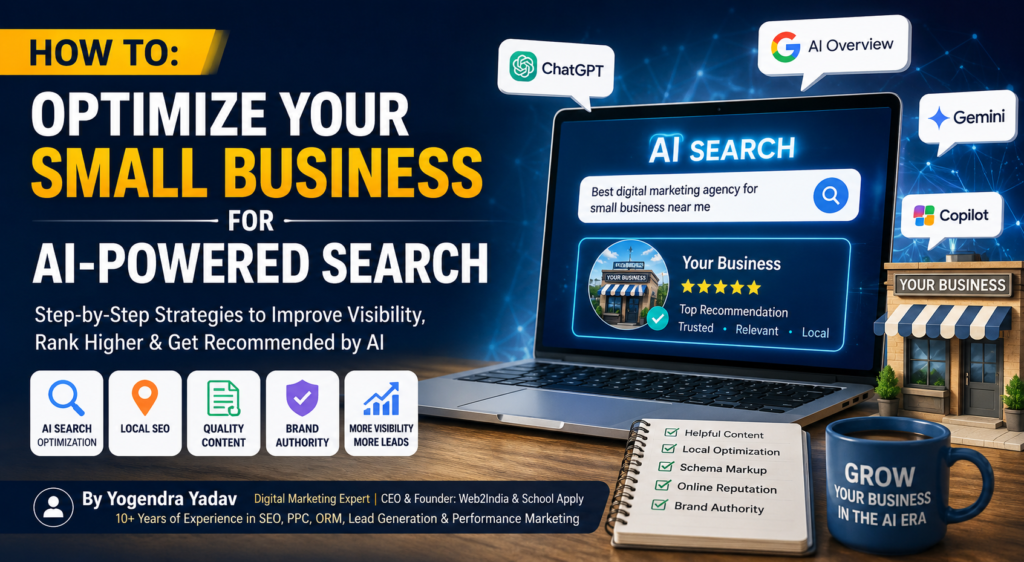
Artificial Intelligence is changing the way people search online. Earlier, users typed short keywords into search engines like Google. Today, they ask complete questions to AI tools such as OpenAI ChatGPT, Google Gemini, Microsoft Copilot, and Perplexity AI.
Instead of browsing multiple websites, users now expect direct answers, recommendations, and trusted business suggestions from AI-powered search systems.
This shift is creating a massive opportunity for small businesses.
The businesses that adapt early will gain:
- Higher online visibility
- More organic leads
- Better trust and authority
- Increased local reach
- Long-term digital growth
The question is no longer:
“How do I rank on Google?”
The real question is:
“How do I become the business AI recommends?”
In this guide, you will learn step-by-step how to optimize your small business for AI-powered search and future-proof your digital presence.
What Is AI-Powered Search?
AI-powered search refers to search experiences where Artificial Intelligence generates answers instead of simply showing a list of websites.
Examples include:
- Google AI Overview
- ChatGPT recommendations
- Gemini answers
- Voice search assistants
- AI-generated summaries
- Conversational search results
For example, instead of typing:
“Best digital marketing agency Delhi”
Users now ask:
“Which digital marketing agency is best for lead generation and SEO in Delhi for small businesses?”
AI systems analyze:
- Website content
- Online reputation
- Customer reviews
- Brand authority
- Social presence
- Content relevance
- User engagement
Then they recommend businesses they trust.
Why Small Businesses Must Adapt Now
Large brands already invest heavily in AI optimization. However, small businesses still have a major advantage:
- Faster adaptation
- Niche expertise
- Local trust
- Personalized customer experience
If optimized properly, even a small local business can outrank bigger competitors in AI recommendations.
Businesses ignoring AI search may soon experience:
- Lower organic traffic
- Reduced visibility
- Fewer leads
- Decreasing trust signals
AI optimization is no longer optional. It is becoming the new foundation of digital marketing.
Step 1: Build a Strong Website Foundation
Your website is the primary source AI uses to understand your business.
Important Website Elements:
Clear Business Information
Your website must clearly mention:
- Business name
- Services
- Location
- Contact information
- About section
- Expertise
Fast Loading Speed
AI and search engines prioritize websites that load quickly.
Use:
- Optimized images
- Fast hosting
- Mobile-friendly design
- Lightweight themes
Mobile Optimization
Most searches now happen on mobile devices.
Your website should:
- Load properly on phones
- Have readable text
- Include click-to-call buttons
- Offer smooth navigation
Step 2: Focus on Conversational SEO
Traditional SEO targeted short keywords.
AI search focuses on:
- Questions
- Intent
- Natural language
- Human conversation
Example:
Instead of targeting:
“SEO services Delhi”
Create content around:
“How can SEO help small businesses generate leads in Delhi?”
This improves your chances of appearing in AI-generated answers.
Step 3: Create Helpful, Human-Centric Content
AI systems reward websites that genuinely help users.
Your content should:
- Solve problems
- Educate readers
- Answer questions clearly
- Provide actionable insights
Content Types AI Loves:
| Content Type | Example |
|---|---|
| Guides | Beginner’s Guide to Digital Marketing |
| FAQs | What Is Local SEO? |
| Tutorials | How To Run Facebook Ads |
| Case Studies | How a School Increased Admissions by 60% |
| Comparisons | SEO vs PPC for Small Businesses |
| Checklists | Website Optimization Checklist |
Step 4: Use AI-Friendly Content Structure
AI tools prefer structured and readable content.
Best Practices:
Use Proper Headings
Use:
- H1 for titles
- H2 for main sections
- H3 for subtopics
Write Short Paragraphs
Avoid long blocks of text.
Add Bullet Points
AI easily extracts bullet-based information.
Answer Questions Directly
Example:
Question:
How does local SEO help small businesses?
Answer:
Local SEO improves visibility in nearby searches, helping businesses attract more local customers through Google Maps and location-based search results.
Step 5: Optimize for Local AI Search
Many AI searches are location-based.
Examples:
- “Best dentist near me”
- “Top schools in Delhi”
- “Affordable digital marketing agency nearby”
To Improve Local Visibility:
Create & Optimize Google Business Profile
Include:
- Photos
- Reviews
- Services
- Business timings
- Website link
Maintain NAP Consistency
NAP = Name, Address, Phone Number
Keep it identical across:
- Website
- Directories
- Social media
- Maps listings
Encourage Customer Reviews
Positive reviews improve trust signals for AI systems.
Step 6: Build Brand Authority
AI recommends trusted brands.
Ways to Build Authority:
Publish Expert Content
Write blogs under your real name.
Example:
“Written by Yogendra Yadav – Performance Marketing Expert”
This builds expertise signals.
Earn Backlinks
Get mentioned on:
- News websites
- Industry blogs
- Business directories
- Podcasts
Be Active on Social Media
AI also analyzes social engagement.
Stay active on:
- YouTube
Step 7: Add FAQ Sections
FAQs are extremely important for AI optimization because AI systems often pull answers directly from them.
Example FAQ:
Q: What is AI-powered search?
AI-powered search uses Artificial Intelligence to provide direct answers and recommendations instead of traditional website listings.
Q: Why is AI optimization important?
AI optimization helps businesses improve visibility, credibility, and lead generation in modern search experiences.
Step 8: Use Schema Markup
Schema helps search engines and AI understand your website better.
Important schema types:
- Local Business Schema
- FAQ Schema
- Review Schema
- Article Schema
Schema improves:
- Rich results
- AI comprehension
- Search visibility
Step 9: Create Multi-Platform Content
AI learns from multiple platforms.
Repurpose your content into:
- Blog posts
- LinkedIn articles
- Instagram carousels
- YouTube videos
- Short reels
- Podcasts
This increases brand visibility across the digital ecosystem.
Step 10: Monitor Your Online Reputation
AI systems evaluate sentiment and trust.
Reputation Management Tips:
- Respond to reviews professionally
- Address customer complaints quickly
- Publish success stories
- Share testimonials
- Highlight achievements and awards
A strong online reputation increases AI trust signals.
Common Mistakes Small Businesses Should Avoid
❌ Keyword Stuffing
Overusing keywords reduces readability and trust.
❌ Thin Content
Short, low-value articles rarely perform well.
❌ Duplicate Content
Copied content weakens authority.
❌ Ignoring Mobile Users
Poor mobile experience reduces rankings.
❌ Inconsistent Brand Information
Different business details confuse AI systems.
The Future of AI Search
AI search will continue evolving rapidly.
Future trends include:
- Voice-driven search
- Personalized AI recommendations
- Visual AI search
- AI shopping assistants
- Predictive search experiences
Businesses that build trust, authority, and user-focused content today will dominate tomorrow.
Final Thoughts
Optimizing your small business for AI-powered search is not about manipulating algorithms. It is about:
- Creating valuable content
- Building trust
- Solving customer problems
- Maintaining digital consistency
- Becoming a recognized authority
AI systems recommend businesses that are:
- Helpful
- Reliable
- Trusted
- Consistent
- User-focused
If your business focuses on delivering genuine value online, AI will naturally begin recommending your brand.
The future belongs to businesses that adapt early.
Start today.
About The Author
Yogendra Yadav
Yogendra Yadav is a Performance Marketing Expert with over 10 years of experience in:
- SEO
- SMO
- PPC
- ORM
- Email Marketing
- WhatsApp Marketing
- Lead Generation
- AI Search Optimization
As the Founder & CEO of Web2India and School Apply, he helps businesses, educational institutions, and startups build scalable digital growth strategies through search engine optimization, AI-driven visibility, and performance marketing.
His mission is to help brands stay future-ready in the rapidly evolving AI-powered digital landscape.